On the morning of May 16, the Seminar on Numerical Methods for Partial Differential Equations and Scientific Computing, hosted by the Northeast Center of the National Tianyuan Mathematics and the School of Mathematics of Jilin University, opened at the Dongrong Conference Center on the central campus of Jilin University.
Professor Tang Tao, President of Southern College of Guangzhou, Professor Chen Zhiming from the Academy of Mathematics and Systems Science, Chinese Academy of Sciences, and Professor Zhang Zhimin from Wayne State University attended the seminar. Zhang Ran, member of the Standing Committee of the Party Committee and Vice President of Jilin University, attended the opening ceremony of the seminar and delivered a speech. The opening ceremony was hosted by Lü Peiqing, Secretary of the Party Committee of the School of Mathematics, Jilin University.
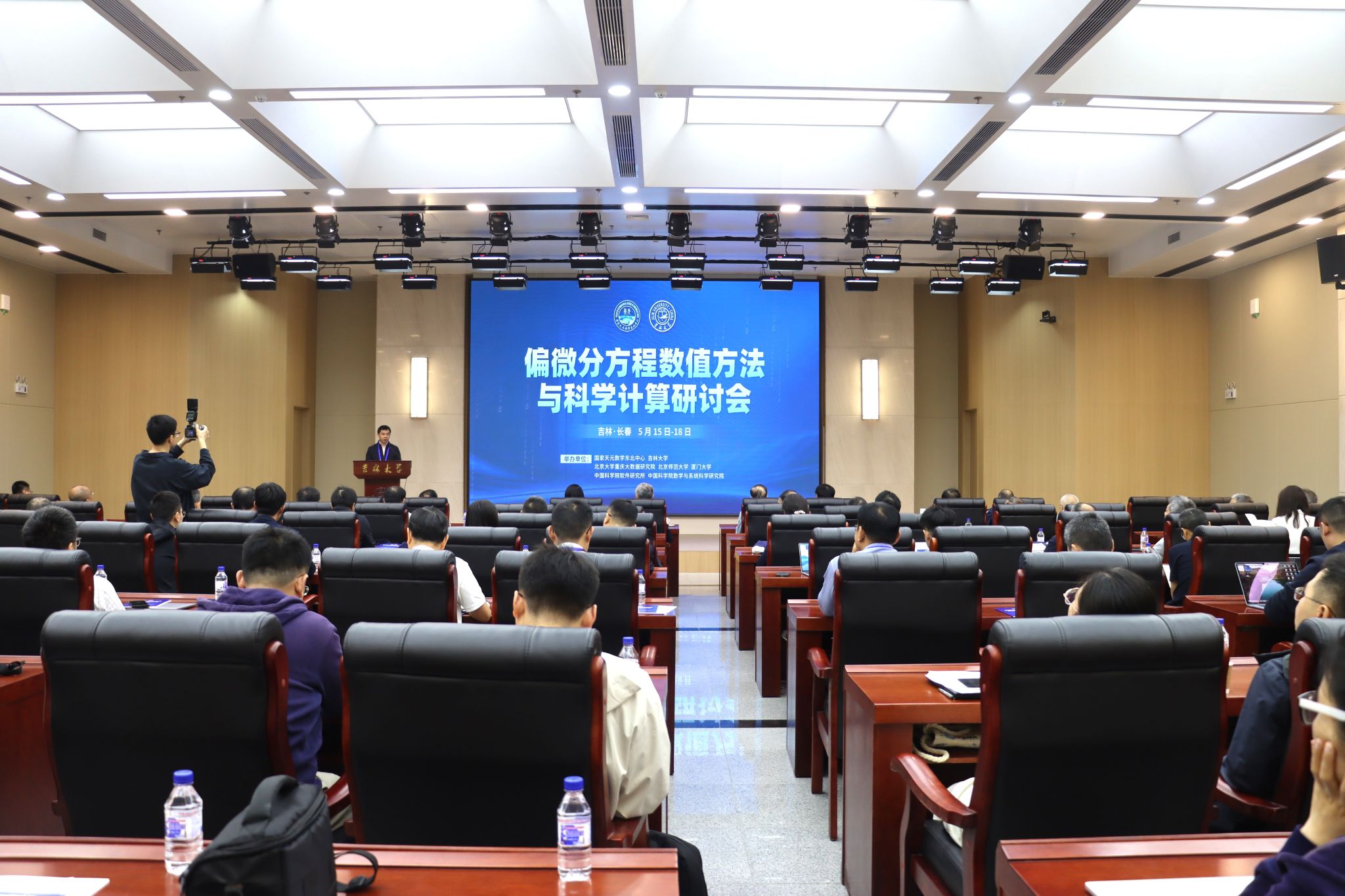

In her speech, Zhang Ran, on behalf of the Party Secretary of the university, Tian Hui, and the President, Zhang Xi, extended a warm welcome to all the experts and scholars attending the seminar, and expressed her heartfelt gratitude to all colleagues who have long cared for and supported the development of Jilin University, especially the construction of the mathematics discipline and the establishment of the National Tanyuan Mathematics Northeast Center.
She stated that Jilin University has always adhered to the original mission of fostering virtue through education, consistently placing the quality of talent cultivation at the forefront of its educational and administrative efforts. The mathematics department at Jilin University has a long-standing tradition of nurturing talent, instilling a deep sense of national sentiment, and has produced a large number of outstanding professionals for the development of mathematics in China. Computational mathematics, serving as a bridge between mathematical theory and engineering practice, is not only an important extension of fundamental mathematics but also a core support in key fields such as aerospace, artificial intelligence, advanced manufacturing, and life and health sciences. Guided by the "Four Orientations", computational mathematics professionals bear the era-defining mission of empowering high-level scientific and technological self-reliance through algorithmic innovation. She pointed out that this symposium has brought together many influential experts and scholars in the field of computational mathematics from both domestic and international circles, fully reflecting the support and attention from colleagues at home and abroad. She hopes that the experts will speak freely and exchange ideas, and also hopes that young scholars and students will cherish this rare opportunity for learning and communication, actively seek guidance, expand their academic horizons, and enhance their research capabilities. She hopes that this symposium will serve as an opportunity to accelerate the connotative and high-quality development of mathematics disciplines and the National Turing Mathematics Northeast Center, contributing wisdom and strength to the high-quality development of scientific computing in China and the cultivation of top-notch innovative talent.

In his speech, Zhang Zhimin expressed that he was very pleased with the enthusiastic response from many domestic and international scholars to this seminar. He thanked Jilin University for its long-term strong support of academic exchanges in the field of scientific and engineering computing, and he appreciated the hard work of the School of Mathematics at Jilin University and all the young scholars in preparing for the conference. He looked forward to the participating experts and scholars engaging in thorough exchanges and deep cooperation through this conference, jointly promoting international academic exchange and collaborative development in the field of numerical methods for partial differential equations and scientific computing.
This seminar invited more than 20 experts and scholars from universities and research institutes across the country, as well as from the United States, Japan, Hong Kong, China, and other regions, to deliver specialized academic reports, share cutting-edge research results and international academic developments, and promote exchange and mutual learning of academic ideas between China and abroad. The content covers time and space discretization methods for partial differential equations, structure-preserving algorithms, long-term dynamic simulations, spectral and eigenvalue problems and their applications, efficient solution methods for discrete systems, as well as numerical simulations and related applications in fluid mechanics, electromagnetism, and materials. In addition, the conference also focuses on emerging interdisciplinary fields such as artificial intelligence and quantum computing, promoting the exchange and integration between traditional numerical methods and modern computational technologies.

It is reported that this seminar was co-hosted by the Chongqing Big Data Research Institute of Peking University, Beijing Normal University, Xiamen University, the Institute of Software of the Chinese Academy of Sciences, and the Academy of Mathematics and Systems Science of the Chinese Academy of Sciences. More than 60 experts, scholars, and representatives of faculty and students from over 20 universities and research institutes at home and abroad participated in this seminar.